

BioLumi UE5 (Thesis Research)
BioLumi UE5 (Thesis Research)
BioLumi UE5 (Thesis Research)
Interactive environments often approximate fluids and glow effects through pre-authored particles or surface shaders, limiting physical consistency and responsiveness. This research investigates how a GPU-accelerated fluid simulation implemented in Unreal Engine can generate physically accurate reactive bio-luminescent behavior across water and snow environments. In coupling fluid motion with light propagation and collision response, the system aims to enhance user experience through improved material realism within real-time performance constraints.
Interactive environments often approximate fluids and glow effects through pre-authored particles or surface shaders, limiting physical consistency and responsiveness. This research investigates how a GPU-accelerated fluid simulation implemented in Unreal Engine can generate physically accurate reactive bio-luminescent behavior across water and snow environments. In coupling fluid motion with light propagation and collision response, the system aims to enhance user experience through improved material realism within real-time performance constraints.
Interactive environments often approximate fluids and glow effects through pre-authored particles or surface shaders, limiting physical consistency and responsiveness. This research investigates how a GPU-accelerated fluid simulation implemented in Unreal Engine can generate physically accurate reactive bio-luminescent behavior across water and snow environments. In coupling fluid motion with light propagation and collision response, the system aims to enhance user experience through improved material realism within real-time performance constraints.
Type
UE5, Simulation, Fluid Solver
Type
UE5, Simulation, Fluid Solver
Development
In Progress
Development
In Progress
Reading Time
~ 1 minute
Reading Time
~ 1 minute
Written
03.24.26
Written
03.24.26
Real-Time Simulation of Bio-luminescent Light Propagation in Water and Snow within Unreal Engine 5
Real-Time Simulation of Bio-luminescent Light Propagation in Water and Snow within Unreal Engine 5
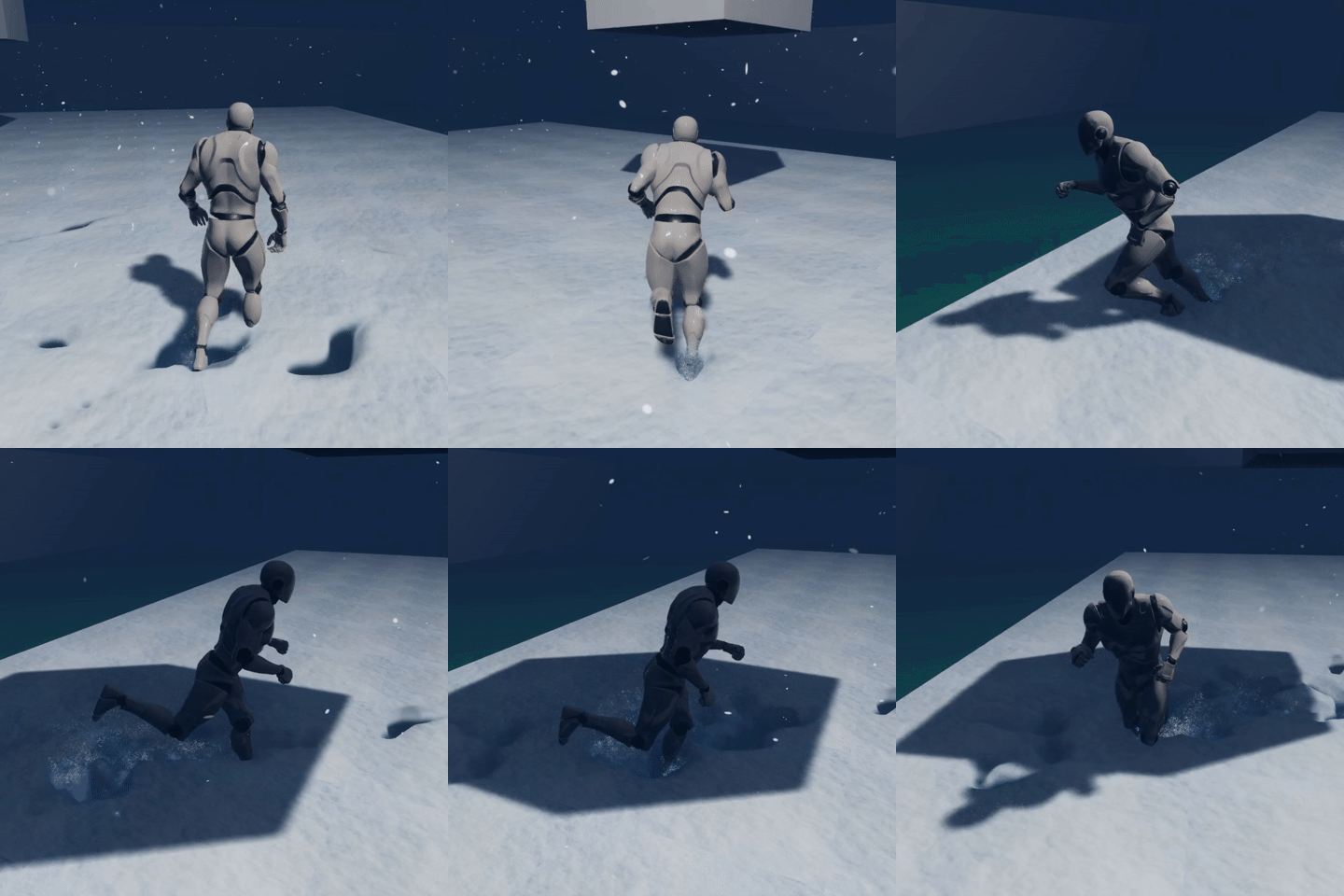
Figure 1: Snapshot of Progress of Bioluminescence in Snow using Parallax Mapping
Figure 1: Snapshot of Progress of Bioluminescence in Snow using Parallax Mapping
Currently Still in Development (Below is Research Proposal)
Currently Still in Development (Below is Research Proposal)
Previous Work
Previous Work
Prior work in real-time environmental simulation has explored both deformable snow systems and GPU-based fluid solvers, though typically as separate domains. Several implementations leverage render targets and collision detection components to dynamically displace surface geometry [Leo 2023], skipping the integration of physically grounded volumetric diffusion or light propagation through the medium. Other real-time fluid frameworks such as Fluid Ninja Live demonstrate that GPU-accelerated two-dimensional solvers operating on grid-based representations can be used to produce interactive fluid behavior [80 Level 2023] [Ketzer 2023].
Prior work in real-time environmental simulation has explored both deformable snow systems and GPU-based fluid solvers, though typically as separate domains. Several implementations leverage render targets and collision detection components to dynamically displace surface geometry [Leo 2023], skipping the integration of physically grounded volumetric diffusion or light propagation through the medium. Other real-time fluid frameworks such as Fluid Ninja Live demonstrate that GPU-accelerated two-dimensional solvers operating on grid-based representations can be used to produce interactive fluid behavior [80 Level 2023] [Ketzer 2023].
Proposal
Proposal
This research proposes the design and implementation of a realtime, GPU-accelerated fluid simulation system in Unreal Engine that models reactive bio-luminescent fluid behavior for interactive digital environments. Rather than treating glowing fluid as a purely aesthetic particle effect, this project aims to simulate light emission as an emergent property of fluid motion and interaction forces, draw conceptual grounding from fluid dynamics research in visual computational studies [Stam 1999]. It will follow the typical framework for a interactive environment however will be extended with the necessary complexities.
This research proposes the design and implementation of a realtime, GPU-accelerated fluid simulation system in Unreal Engine that models reactive bio-luminescent fluid behavior for interactive digital environments. Rather than treating glowing fluid as a purely aesthetic particle effect, this project aims to simulate light emission as an emergent property of fluid motion and interaction forces, draw conceptual grounding from fluid dynamics research in visual computational studies [Stam 1999]. It will follow the typical framework for a interactive environment however will be extended with the necessary complexities.

Figure 2: Biolumen Simulation Infrastructure
Figure 2: Biolumen Simulation Infrastructure
Detection Component (D) This actor component is meant to be attached to an object or point constraint as a sensor to drive the simulation.
Tracking Manager (TM) Exists as an entity in the world and creates live texture maps from the detection components to store location, velocity, and depth.
Simulation Authorities (SM/LM) Handles the logistical and visual representation of the light propagation. The Simulation Manager is part of this class and acts as a solver authority handling the calculations using the Navier Stokes approach at each TimeStep.
The Landscape Manager acts as the projection authority handling the presentation of the simulation in the environment.
Detection Component (D) This actor component is meant to be attached to an object or point constraint as a sensor to drive the simulation.
Tracking Manager (TM) Exists as an entity in the world and creates live texture maps from the detection components to store location, velocity, and depth.
Simulation Authorities (SM/LM) Handles the logistical and visual representation of the light propagation. The Simulation Manager is part of this class and acts as a solver authority handling the calculations using the Navier Stokes approach at each TimeStep.
The Landscape Manager acts as the projection authority handling the presentation of the simulation in the environment.
Validation or Proposed User Studies
Validation or Proposed User Studies
The simulation will be developed and tested through two environmental case studies, water and snow, to evaluate physical plausibility and system adaptability. Water will serve as a dynamic, freely flowing medium in which bio-luminescent emission propagates through velocity fields and surface displacement. Snow will function as a semi-static, deformable surface where luminous diffusion spreads across and within a porous material structure.
The simulation will be developed and tested through two environmental case studies, water and snow, to evaluate physical plausibility and system adaptability. Water will serve as a dynamic, freely flowing medium in which bio-luminescent emission propagates through velocity fields and surface displacement. Snow will function as a semi-static, deformable surface where luminous diffusion spreads across and within a porous material structure.
Challenges
Challenges
Several interconnected challenges are presented across implementation, simulation fidelity and performance optimization being the most critical. Developing a GPU-accelerated fluid system within Unreal Engine also introduces a personal significant learning curve, particularly in integrating custom compute shaders, render targets, and profiling tools. The system must also adapt to materially distinct case studies without fragmenting into separate architectures. Additionally rendering the 2D simulation as a volumetric 3D effect through ray marching and parallax occlusion mapping further increases computational cost making optimization for lower end GPUs, potential VR deployment, and multiplayer replication, a central technical challenge.
Several interconnected challenges are presented across implementation, simulation fidelity and performance optimization being the most critical. Developing a GPU-accelerated fluid system within Unreal Engine also introduces a personal significant learning curve, particularly in integrating custom compute shaders, render targets, and profiling tools. The system must also adapt to materially distinct case studies without fragmenting into separate architectures. Additionally rendering the 2D simulation as a volumetric 3D effect through ray marching and parallax occlusion mapping further increases computational cost making optimization for lower end GPUs, potential VR deployment, and multiplayer replication, a central technical challenge.
References
References
80 LEVEL, 2023. Adding depth and realism to 2d fluids in unreal.
80.lv article.
HARRIS, M. J. 2004. Fast fluid dynamics simulation on the gpu.
In GPU Gems: Programming Techniques, Tips, and Tricks for
Real-Time Graphics, M. Pharr, Ed. Addison-Wesley.
KETZER, A., 2023. Fluid ninja live manual. Available via Scribd.
LEO, K., 2023. How to create aaa-level deformable snow in unreal
engine 5. Medium article.
STAM, J. 1999. Stable fluids. Proceedings of the 26th Annual
Conference on Computer Graphics and Interactive Techniques
(SIGGRAPH).
80 LEVEL, 2023. Adding depth and realism to 2d fluids in unreal.
80.lv article.
HARRIS, M. J. 2004. Fast fluid dynamics simulation on the gpu.
In GPU Gems: Programming Techniques, Tips, and Tricks for
Real-Time Graphics, M. Pharr, Ed. Addison-Wesley.
KETZER, A., 2023. Fluid ninja live manual. Available via Scribd.
LEO, K., 2023. How to create aaa-level deformable snow in unreal
engine 5. Medium article.
STAM, J. 1999. Stable fluids. Proceedings of the 26th Annual
Conference on Computer Graphics and Interactive Techniques
(SIGGRAPH).
80 LEVEL, 2023. Adding depth and realism to 2d fluids in unreal.
80.lv article.
HARRIS, M. J. 2004. Fast fluid dynamics simulation on the gpu.
In GPU Gems: Programming Techniques, Tips, and Tricks for
Real-Time Graphics, M. Pharr, Ed. Addison-Wesley.
KETZER, A., 2023. Fluid ninja live manual. Available via Scribd.
LEO, K., 2023. How to create aaa-level deformable snow in unreal
engine 5. Medium article.
STAM, J. 1999. Stable fluids. Proceedings of the 26th Annual
Conference on Computer Graphics and Interactive Techniques
(SIGGRAPH).
Thank You for Playing!



Thank You for Playing!
Thank You for Playing!